
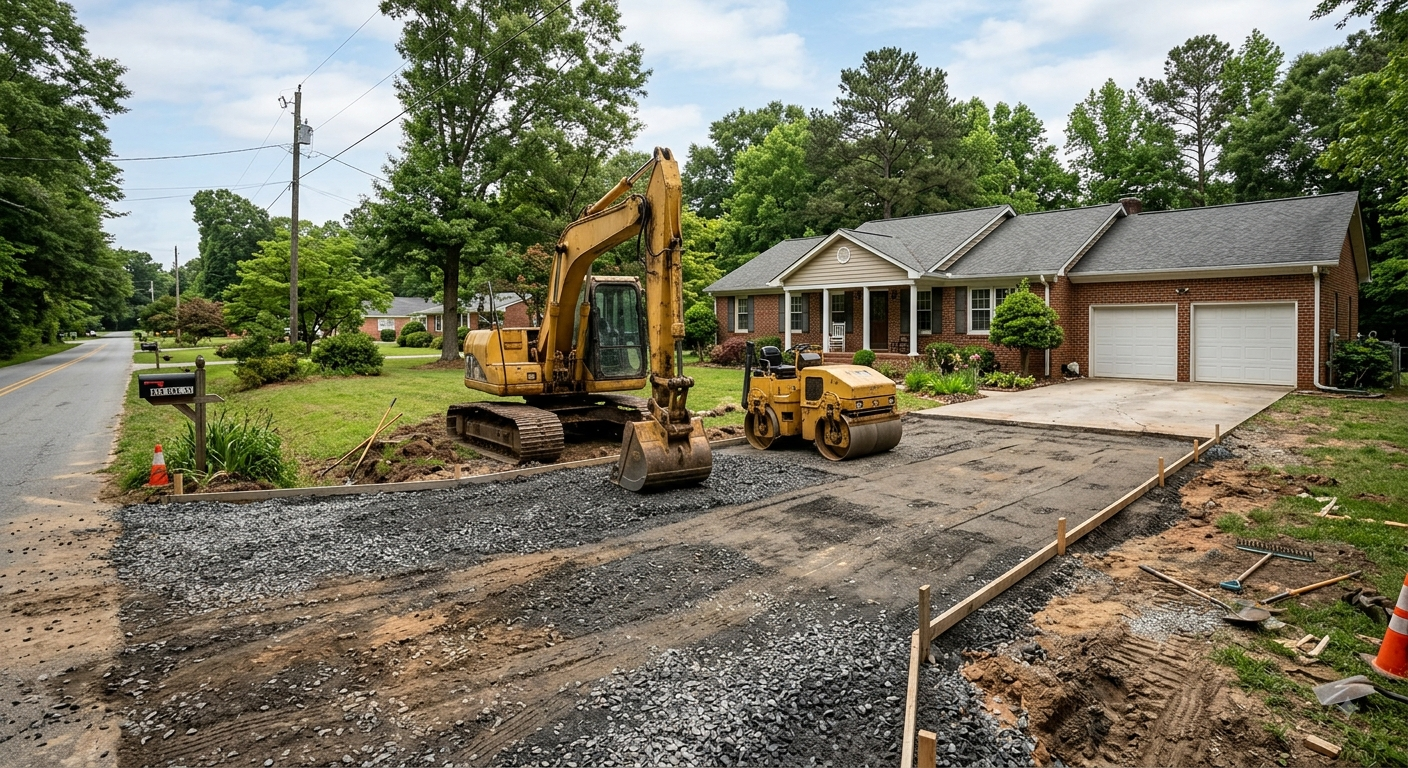
Vehicle Access Built for Long-Term Function
Driveway Construction in Siler City for residential and commercial properties that lack defined, stable vehicle access to structures or parking areas
A driveway that channels water away from the driving surface, handles vehicle weight without rutting, and connects cleanly to the road starts with site preparation—not surface material. Ferguson's Handyman Service constructs driveways for residential and commercial properties in Siler City, Burlington, Chapel Hill, and surrounding areas beginning with grade, drainage, and subbase before any surface goes down. Properties without defined access, or those with access that has deteriorated past practical repair, benefit from a construction approach that treats the ground preparation phase as foundational rather than optional.
Driveway construction begins with site evaluation and subbase preparation before any surface material is applied. The existing grade needs to direct water away from structures and prevent pooling on the driveway surface itself—water that sits on a driving surface accelerates deterioration regardless of what that surface is made of. In Siler City, where clay soil underlies much of the area, subbase compaction and drainage planning are particularly important because clay retains moisture and can shift under load when saturated.
Discuss your access needs and site conditions with Ferguson's Handyman Service to determine what a driveway project requires on your specific property.
What Driveway Construction Actually Accomplishes
Driveway construction produces defined, stable vehicle access where none existed or where previous access had failed. The work covers subgrade preparation, base material installation and compaction, and surface application—each phase builds on the last, and skipping base preparation is the most common cause of premature surface failure in residential driveways. The surface material—whether gravel, asphalt, concrete, or another option—is selected after the site and use case are understood, not before.
Once construction is complete, the driveway provides a path that handles vehicle weight without rutting, channels water away from the driving surface, and gives the property a clear, usable access point. The transition from the road surface to the driveway entry should be smooth and properly graded to prevent underbody contact and backflow from the road surface into the driveway approach.
Driveway width, turning radius at the entry, and any needed culvert work at the road connection are all factors addressed during planning. Properties with steep approaches or significant grade change between the road and the parking area may require additional cut and fill work to create a surface grade that remains safe during wet conditions.
Common Questions About Driveway Projects
Driveway construction questions tend to focus on site conditions, what the finished surface needs to handle, and how the project gets sequenced. The specifics depend on your property's terrain and access requirements.
How does drainage affect driveway construction?
A driveway that doesn't direct water away from the surface will fail faster regardless of material; the grade and crown of the driving surface are designed during layout, not adjusted after the fact.
What role does the subbase play in driveway longevity?
The subbase distributes vehicle load across the native soil below; in Siler City's clay soil, a compacted aggregate base is necessary to prevent the surface from shifting, cracking, or rutting under regular traffic.
When should a culvert be installed at a driveway entry?
When the driveway crosses a roadside ditch or drainage swale, a culvert maintains water flow while creating a stable crossing—omitting the culvert causes the ditch to back up and erode the driveway entry over time.
Why does site grade matter for driveway planning?
A steep or uneven grade affects the amount of cut and fill required, the drainage design, and in some cases the surface material selection—all factors that need to be evaluated before construction begins.
What determines the width of the driveway?
Width is driven by intended use—single-vehicle versus multi-vehicle access, turning requirements, and whether the driveway connects to a garage or a turnaround area all factor into the layout decision.
Ferguson's Handyman Service can evaluate your site and outline the construction scope—including grade, drainage, and surface material considerations—based on your property's specific access needs.